
Blog » Algo and automated trading
Algo, bot, EA, trade copier: what's the difference?
Algorithm, bot, EA, automated strategy, trade copier, copy trading… These words are used interchangeably, even though they don't mean the same thing. Here are simple definitions, concrete examples and a table so you know exactly what people are talking about.
What you'll learn
- The difference between an algorithm and a trading bot
- What EA, bot and automated strategy mean
- Why an indicator or an alert is not a bot
- The difference between a trade copier and copy trading
- How to tell which category you are in
The short answer
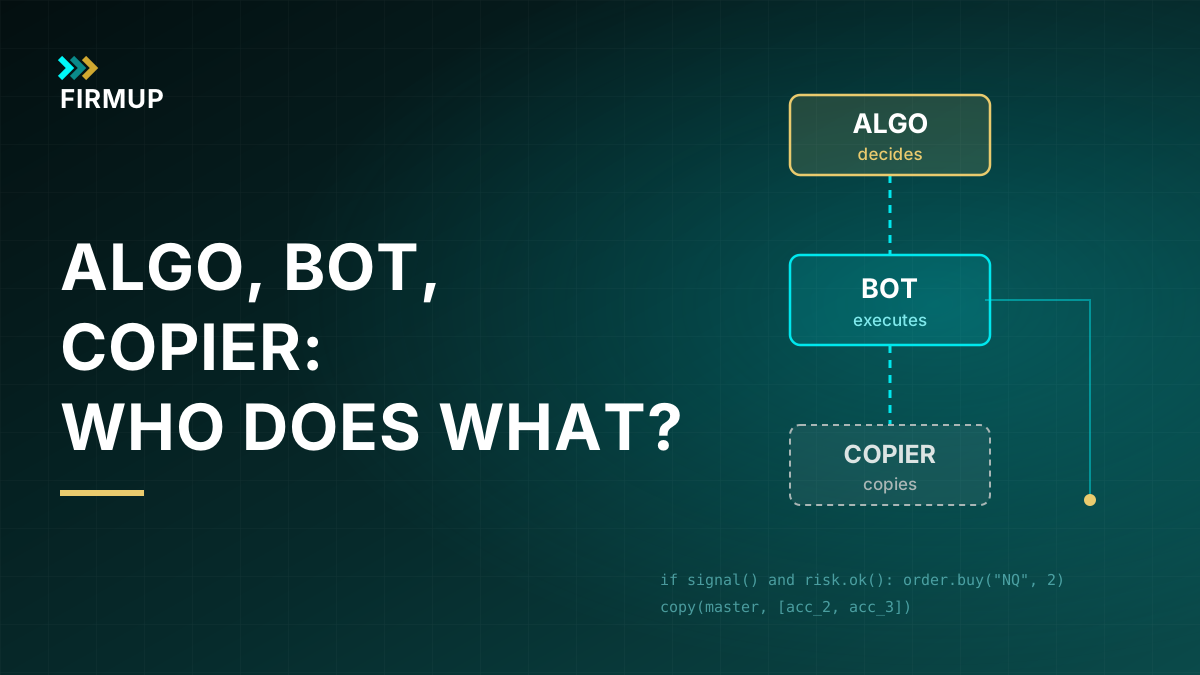
The algorithm decides, the bot executes, the copier copies. The algorithm is the strategy written as rules. The bot is the program that applies those rules and sends the orders on its own. The trade copier, for its part, decides nothing: it duplicates orders that have already been placed onto other accounts. As for an indicator or an alert, it informs you, but you are the one who clicks.
The algorithm: the strategy written as rules
A trading algorithm is a set of precise, unambiguous rules: under what conditions to enter, where to place the stop, when to take profit, what position size, what maximum risk per day. There is no room left for "I have a good feeling about this": every decision follows from a rule.
Example: "buy 2 NQ contracts when the 9 moving average crosses above the 21, stop at 40 ticks, target at 80 ticks, stop trading for the day after two losses". Written on paper, it is already an algorithm. Translated into code, it can become a bot.
People often say "algo trader" to refer to someone who designs their own rules and codes them. It is design work: testing the strategy on historical data (backtest), running it in simulation, measuring its statistics, adjusting it.
The trading bot: the algorithm that places orders on its own
The trading bot is the program that applies the algorithm in real time: it reads market data, checks the conditions and sends the orders itself to the broker or platform, with no human click. It is also called an automated strategy or automated trading.
Depending on the platform, the bot takes different forms: a strategy coded in C# on ATAS or in NinjaScript on NinjaTrader, a custom-built program (Python, C++…) connected to an API, or a TradingView strategy linked to an execution service. The principle stays the same: the program places the order.
EA, bot, automated strategy: different names for the same idea
EA stands for Expert Advisor. It is the name given to bots on MetaTrader (MT4 and MT5), a platform mainly used for Forex and CFDs. An EA is therefore a trading bot, simply called something else on that platform.
The same goes for "bot", "automated strategy" or "automatic system": these terms all refer to a program that places orders on its own. What matters is not the name but the question: who sends the order, you or the program?
Indicator, alert, signal: not a bot
An indicator (moving averages, delta, volume profile, POC…) calculates and displays information. An alert notifies you when a condition is met. A signal suggests an entry. In all three cases, the final decision and the click remain yours: it is manual trading assisted by tools.
This is the most common confusion. A trader who has developed a highly sophisticated custom indicator on ATAS does not have a bot for that reason. It becomes one the day that code places the orders itself.
Trade copier and copy trading: copying is not deciding
The trade copier is a tool that copies the orders of a master account to one or more other accounts. It is often used to trade several accounts at the same time with a single click. It contains no strategy: it duplicates what a trader or a bot has already decided.
Copy trading goes further: it means copying onto your account the trades of another person, for example a trader followed on a platform or a signal provider. You no longer decide anything, and the strategy is not yours.
Neither one is an algorithm. And many prop firm rules treat them separately from bots.
Cases that cause confusion
- Automatic exit management. A stop and a target placed automatically after your entry (OCO orders, NinjaTrader ATM strategies…) automate the exit, but you decided the entry. It is manual trading with automated management.
- A TradingView alert connected to a webhook. An alert on its own is not a bot. If it is sent to a service that places the order automatically, the whole setup becomes an automated strategy.
- "Algo" does not mean "artificial intelligence". Most trading algorithms are fixed rules written by their author. Some use machine learning, but that is not the norm.
- The purchased bot. A commercially sold bot is still a bot, but it is not your algorithm: you did not design it and you often do not control its rules. Several prop firms explicitly distinguish it from a personal bot.
The summary table
| Tool | Who decides? | Who places the order? | Example |
|---|---|---|---|
| Algorithm | The rules written by its author | You or a bot | "Buy on the 9/21 crossover, 40-tick stop" |
| Trading bot, automated strategy | The algorithm | The program | C# strategy on ATAS, NinjaScript, custom code via API |
| EA (Expert Advisor) | The algorithm | The program | Bot installed on MetaTrader 5 |
| Indicator, alert, signal | You | You | Delta, POC, crossover alert |
| Trade copier | The master account (you or a bot) | The copier, by duplication | One click replicated across three accounts |
| Copy trading | Another person | The copy service | Copying the trades of a signal provider |
Which category are you in?
Four questions are enough to place yourself:
- Who sends the entry order? If it is you, you are a manual trader, even with very sophisticated tools.
- Are the rules written and applied without exception? If so, you have an algorithm, coded or not.
- Who designed those rules? If it is you, it is your algorithm. Otherwise, you are using someone else's strategy.
- Does the tool decide or copy? If it copies orders that have already been placed, it is a copier, not a bot.
Why the distinction matters at a prop firm
The rules of futures prop firms do not treat all these tools the same way. In the rulebooks we read on October 12, 2026, several firms distinguish a personal bot from a bot bought from a third party, and regulate the trade copier separately. Before plugging anything in, identify precisely what you are using, then check the corresponding rule.
The firm-by-firm detail is in our comparison Prop firms and trading bots: who allows algo trading in 2026?
Frequently asked questions
What's the difference between an algo and a trading bot?
The algorithm is the strategy written as precise rules. The bot is the program that applies those rules and sends the orders on its own. An algorithm can be applied by hand; a bot, by definition, places orders with no human click.
What is an EA?
EA stands for Expert Advisor: it is the name for trading bots on MetaTrader (MT4 and MT5). An EA works like any other bot: it applies a strategy and places orders automatically.
Is a trade copier a bot?
No. A trade copier copies the orders of a master account to other accounts, without making any decision. It contains no strategy, unlike a bot.
What's the difference between a trade copier and copy trading?
A trade copier duplicates your own orders across several accounts. Copy trading means copying another person's trades, for example a signal provider. In the second case, the strategy is not yours.
Is an indicator with alerts a bot?
No, as long as you are the one placing the order. It becomes one if the alert automatically triggers an order, for example via a webhook connected to an execution service.
Written by the Firmup team · Last updated: October 13, 2026
Are you coding your own algo?
Discover the Algo page →Keep reading
Prop firms and trading bots: who allows algo trading in 2026?
Comparison table of the rules on bots at seven futures prop firms, read on their official pages.
Read the article →
Topstep: are bots allowed? 2026 rules
TopstepX API, VPS, Live Funded accounts: what Topstep allows and prohibits for bots.
Read the article →